I used the interim show to test an idea I had been returning to on and off for some time. Collage plays a significant role in my practice: I often use it as a research tool or as source material for paintings and prints. At times I also make more sculptural collages, though in the past these have usually been temporary objects presented through photography. Last year, I made something more substantial directly on my studio wall, and the results were intriguing. I then used that collage as source material for a series of paintings which were successful to a degree, but which probably did not add much beyond what was already present in the collage itself. I set the experiment aside, thinking I might return to it later.
When I began thinking about the interim show, I knew I wanted to do something experimental. I could have shown paintings or prints, but I wanted to use the relatively low-stakes context as an opportunity to try something out. I was not sure what form that would take until we were shown images of the space and documentation of the previous year’s exhibition. Seeing the a-frames brought the collage idea back to mind, and I proposed making something directly in the space.
I started painting imaginary data centres almost a year ago. It was one of those situations in which the activity led the thinking. When I began making the paintings, there was no particularly well-developed rationale, and I did not imagine that they would become part of the exhibition in Leith. They felt more like a warm-up. As the project developed, however, and as I thought more about the constitutive conditions of AI image production, these paintings became increasingly important. In the end, more than half of the works in the show were data centre paintings. I distributed them throughout the hang so that they operated as moments of punctuation, repeatedly bringing the viewer back to the physical infrastructures and material systems that make AI outputs possible.
For this show, I wanted to expand that visual language to include the GPUs on which data centres depend. Foregrounding these technologies helped materialise the idea that they are not neutral background details, but part of the wider apparatus through which AI images come into being. Bringing them into the work was a way of insisting on that material substrate, and on the fact that these systems are grounded in extraction, energy use, hardware, and industrial-scale computation.
Collage felt like an appropriate process for this because it already carries associations of assembly, fragmentation, and visible construction. It is a method that does not conceal how an image has been built. In contrast to the apparent seamlessness of many AI-generated images, collage makes its joins, ruptures, and decisions legible. It also depends on embodied acts of selection, handling, cutting, placing, and adjustment. In this case, that sense of construction was made even more explicit by the fact that the work was assembled in public. The process unfolded in the space itself, allowing its making to remain highly transparent. Rather than presenting a finished image as though it had arrived fully formed, the work made its own construction visible and, in doing so, offered a counterpoint to the opacity with which AI images are so often produced and encountered.
I experimented for a couple of weeks before the show (see previous posts) and eventually settled on a visual language that I felt I could improvise with once I was in the space. I was conscious of weight, as I needed to transport the paper from Glasgow to London, so I limited myself to a palette of black, blue, orange, red, and silver. GPUs are often made up of largely utilitarian colours, punctuated by flashes of colour in their cables, and this palette grew out of that visual language.
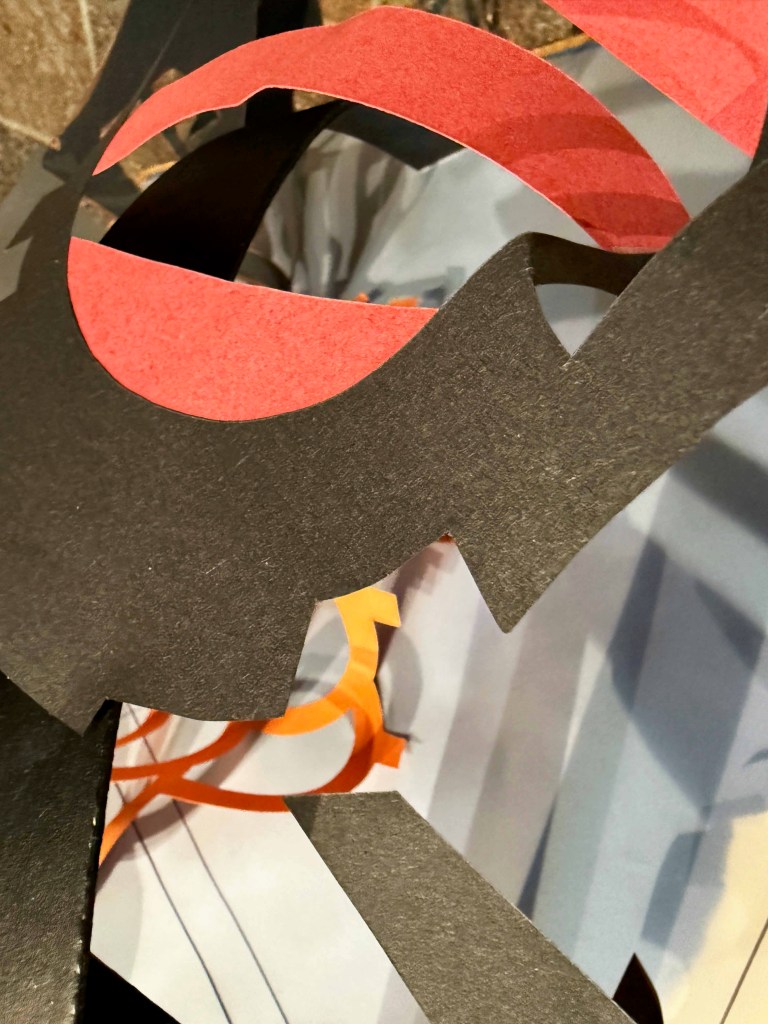
I also knew that I wanted the piece to have a sculptural quality. In the past, I have used greyboard for this purpose, and I decided to do so again here. This time, I painted the strips of greyboard black with acrylic paint. The effect was strong, though there were some problems with the grey showing through when I cut into the board to fold it during the build. Fortunately, I had a Sharpie to hand, which solved the problem well enough.
When I was researching the paintings for the show in Leith, one of the more interesting things that happened was that Midjourney began to hallucinate fish, or elements of fish, even when it was entirely inappropriate to the image I was trying to generate. Earlier in the process, I had been struggling to get the AI to produce an image of a fish-shaped lantern, and I suspect I had pushed that prompt so insistently that the system seemed unable to let go of the fish imagery afterwards. This was one of the moments that really sharpened my fascination with how these machine learning systems operate. It also made me want to bring some of that fish imagery into this piece. It felt playful, but it also pointed back to the strange persistence, slippage, and unpredictability of the system. It may even become a recurring motif as the project develops.
Install Day 1
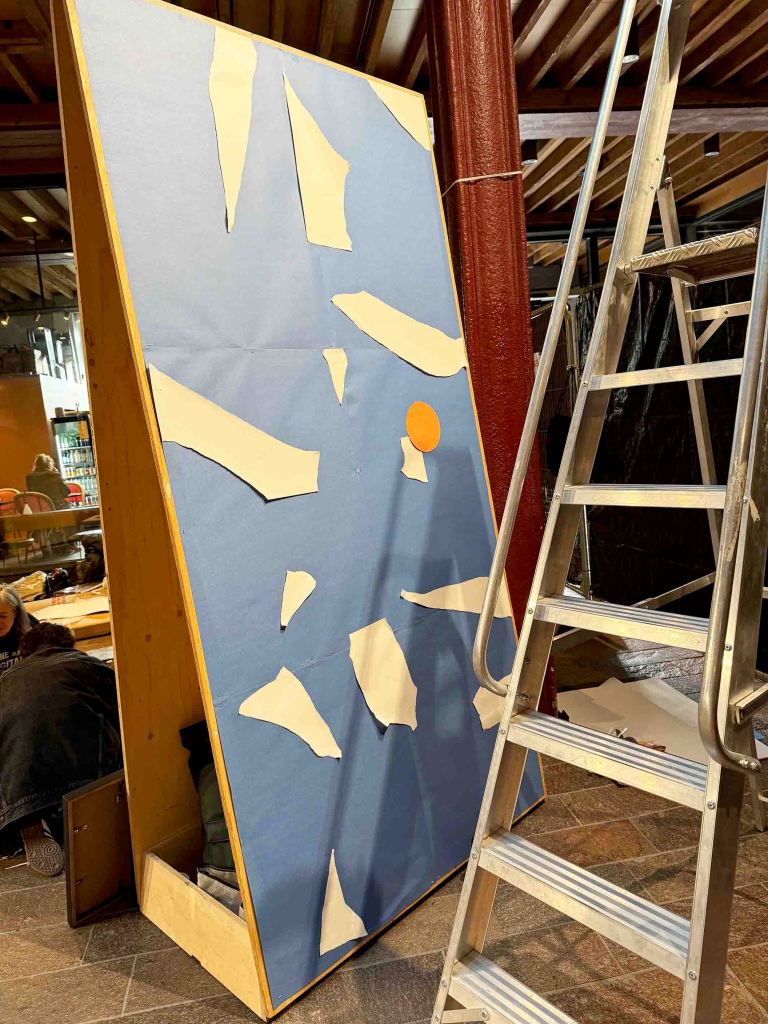
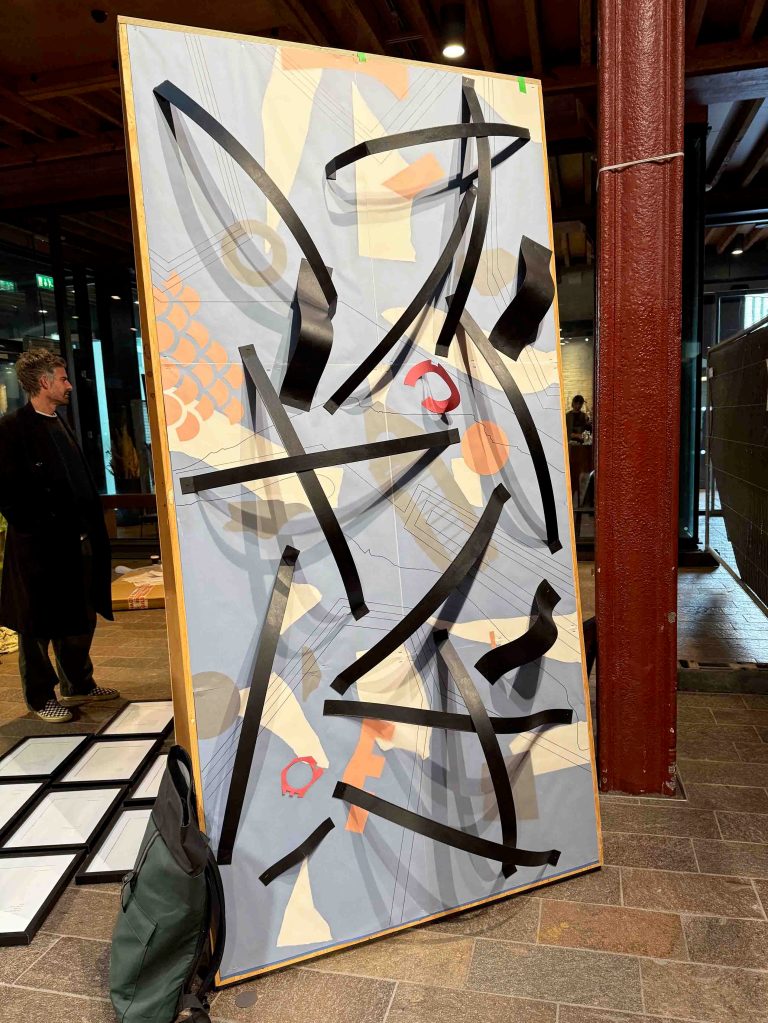
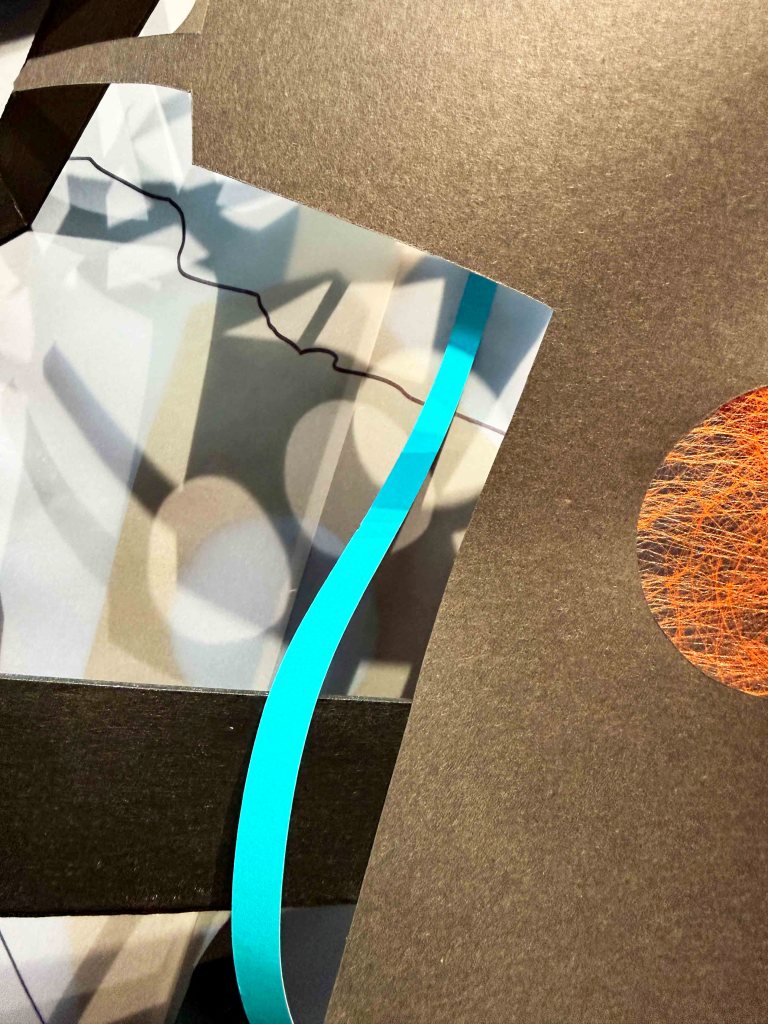
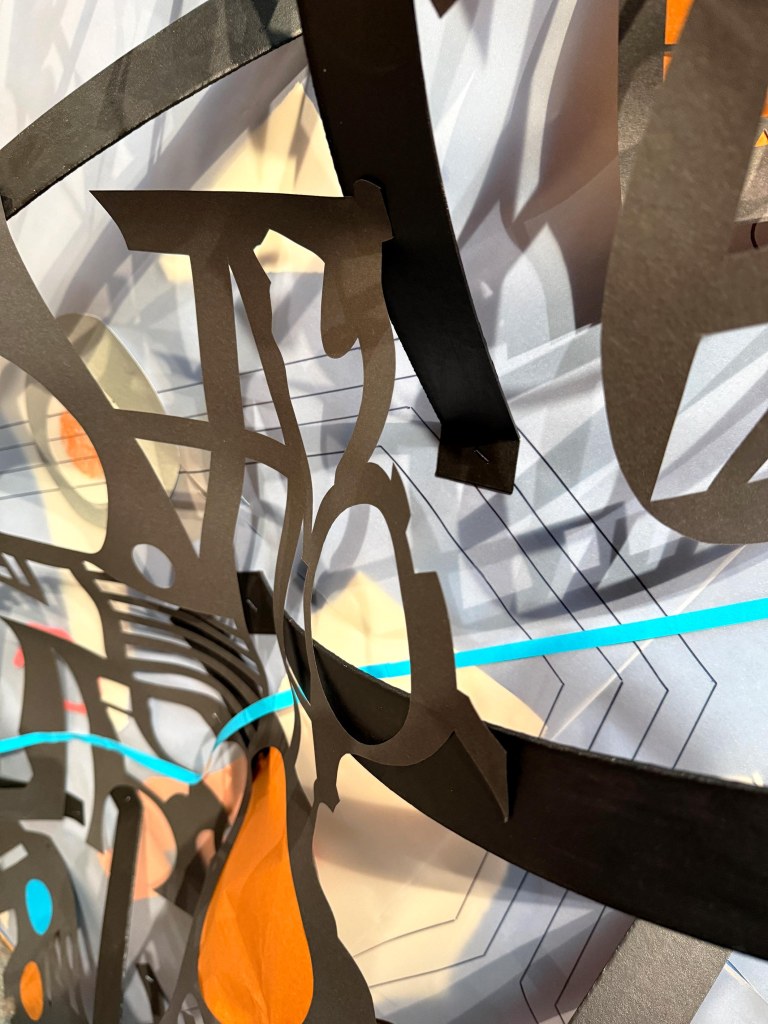
I built a first layer without thinking too much about it, then placed a layer of tracing paper over the top. This immediately created a sense of depth within the piece. I then drew circuit-board-like lines onto the tracing paper with a Sharpie.
This was the first of several moments when someone asked whether the work was finished, which gave me useful food for thought. Although I did not have a fully resolved idea of what the final piece would look like, I did have a fairly clear sense of the stages it would go through, and at that point it was only halfway there. I often find myself asking students why they feel the need to keep working on something, and this was a good reminder that I should sometimes be asking myself the same question.
Next, I added the painted greyboard to create a framework on which to build the more sculptural elements. This is probably the first point at which I would reflect that I might have benefited from being a little more considered. I placed the strips fairly randomly and, as the build developed, realised that I did not actually need all of them. Removing them would have damaged the delicate tracing paper layer, so I left them in place. In retrospect, I think the piece might have achieved a better balance between busy and quieter areas if this stage had been handled with a little more care.
The next stage was to begin experimenting with some of the sugar paper sheets I had cut before coming to London. I had cut shapes derived from the preparatory works into A1 sheets of black sugar paper. I was concerned that these pre-prepared elements might look too rigid or “square”, so I spent the last hour of the first day draping them across the framework to see how they behaved.
The good news was that their rectangular format disappeared very quickly. The less encouraging realisation was that there was a risk the whole piece might become too dominated by black. I decided to leave it there for the day and, that evening, added some colour to the pre-cut paper sheets at home.
Install Day 2
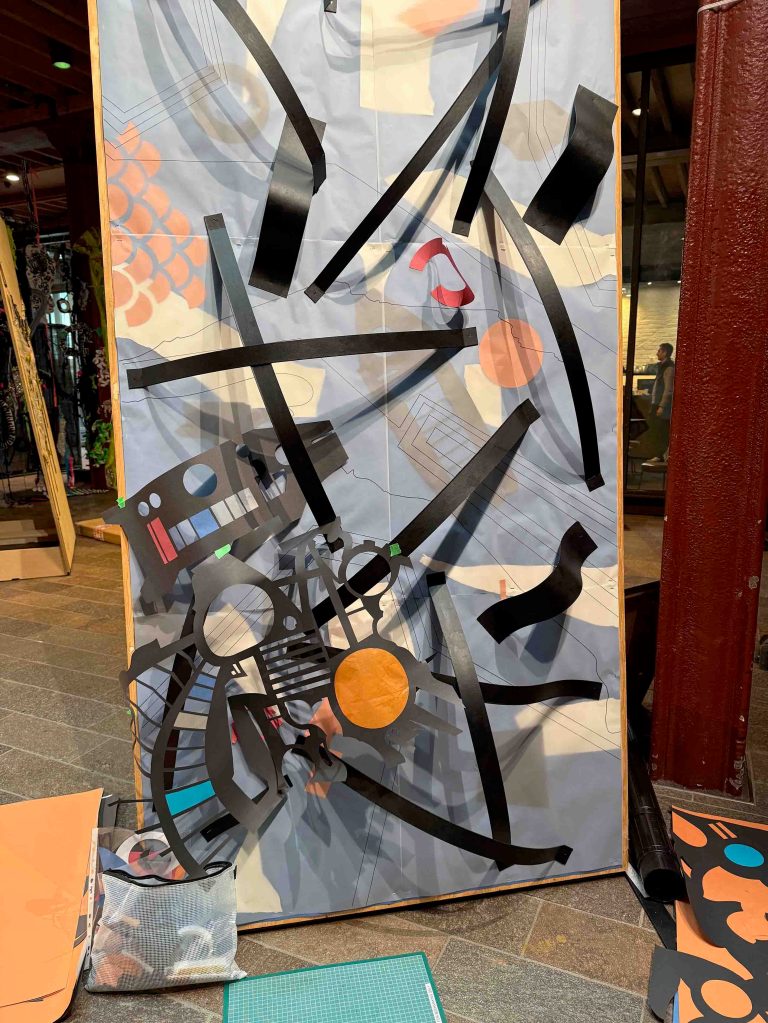
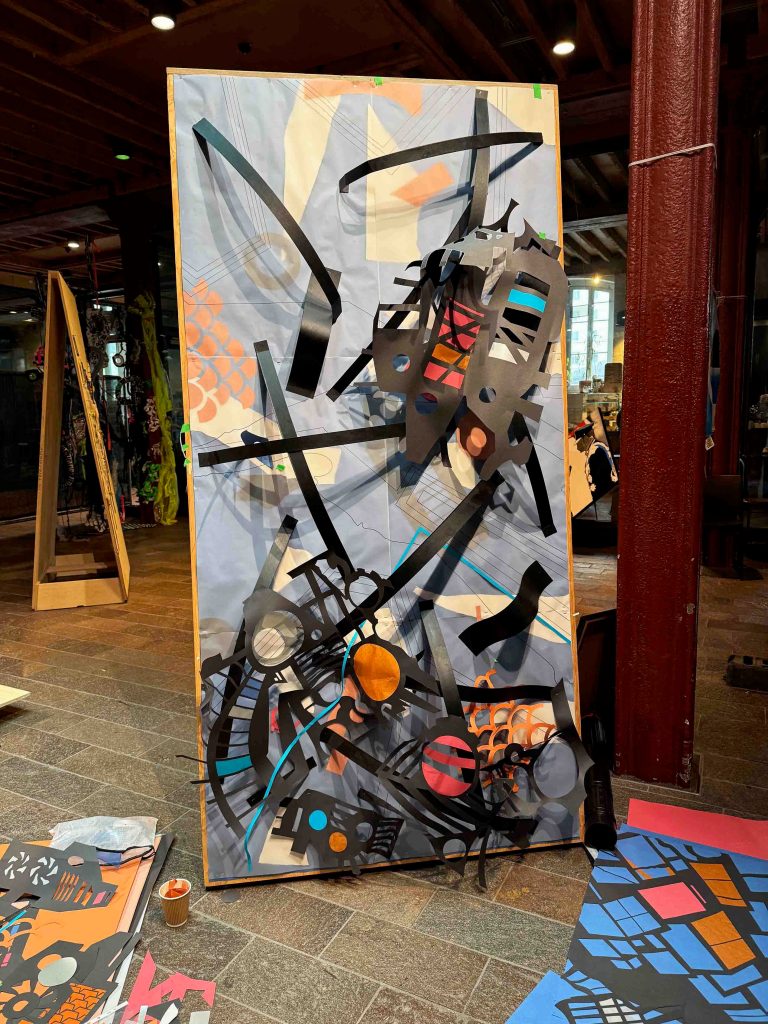
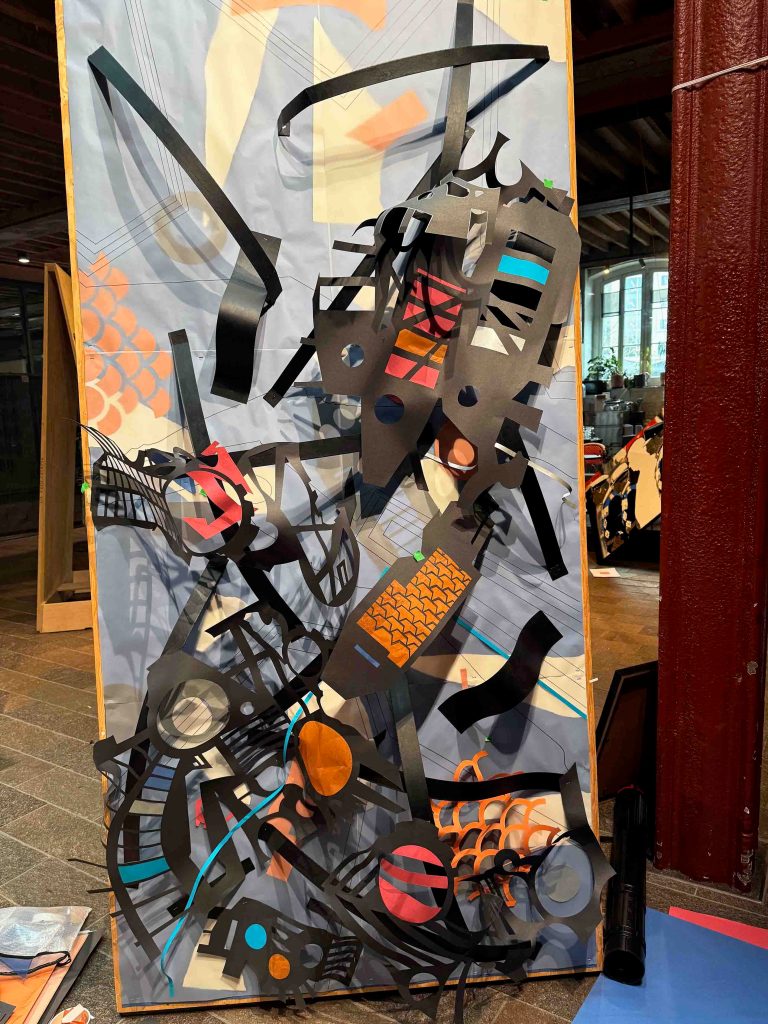
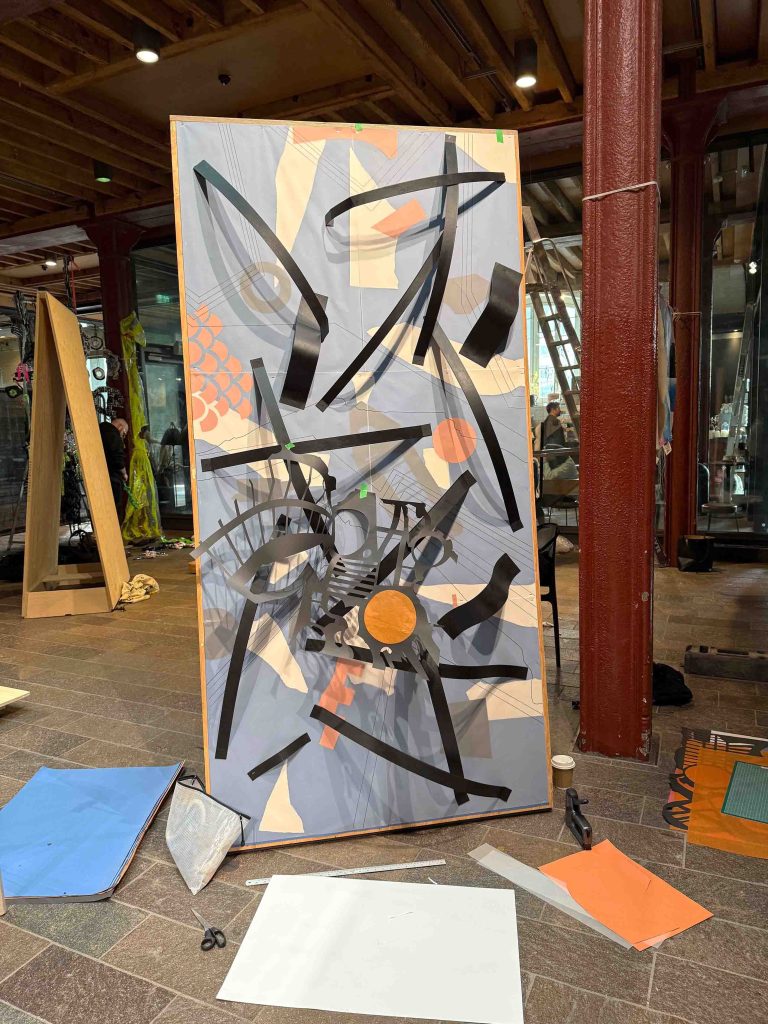
I returned the next day with the revised pre-cut sheets and set to work. I spent a couple of hours attaching pieces with masking tape and repeatedly stepping back to assess the shape and composition. Gradually, an S-shaped structure began to emerge. It gave the piece a pleasing sense of movement, and I tried to work as intuitively as possible in response to that. By the time I decided to stop, I still had a fair amount of pre-cut paper left over, but it felt clear that the piece did not need any more.
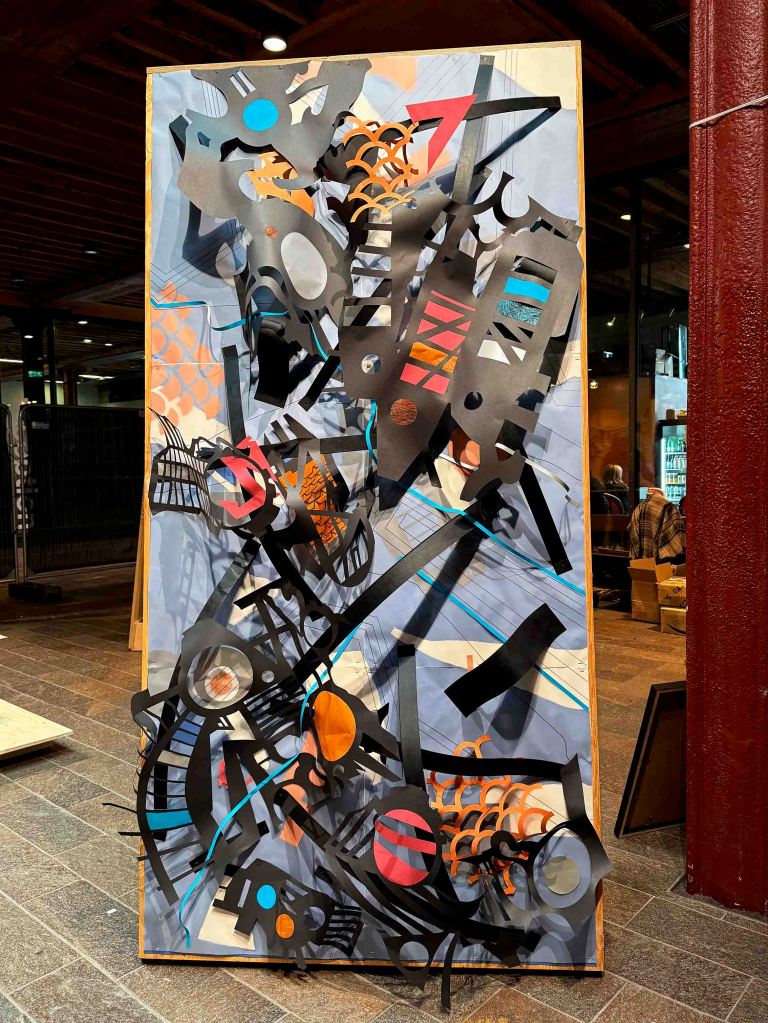
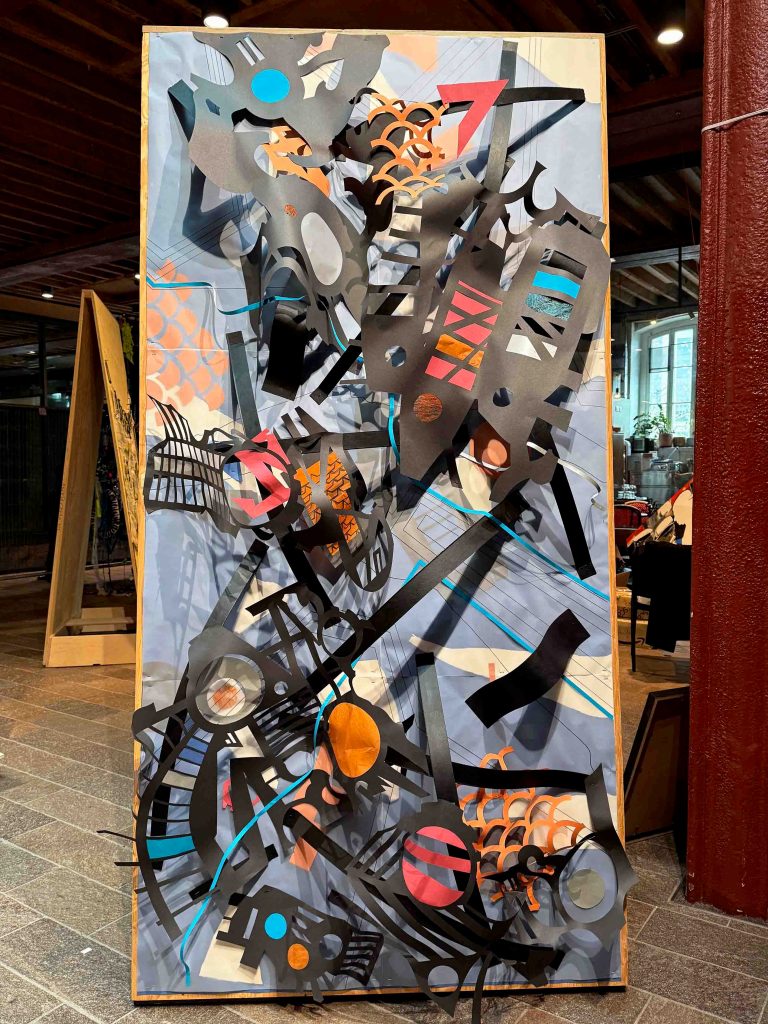
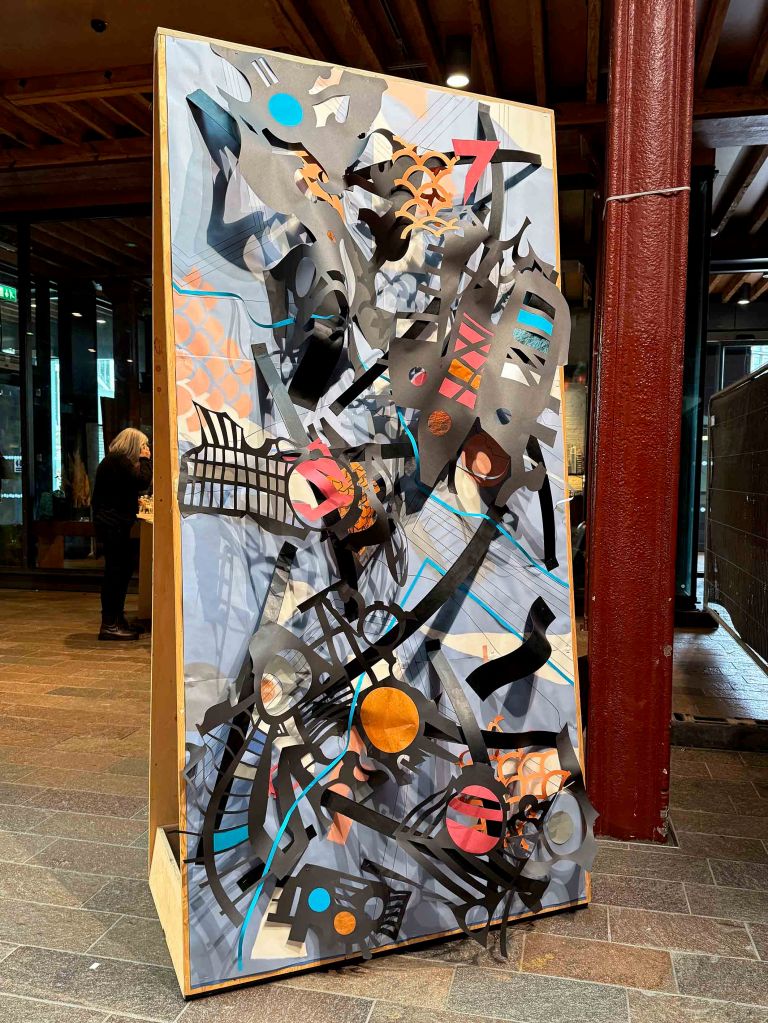
Overall, I am pleased with how the piece developed. I asked for feedback from other students and the teaching team and, while the response was generally very positive, they also gave me a number of useful things to think about.
Some of the main points I am taking from the process are:
I enjoyed making it, and it reminded me how important collage is within my practice, particularly at a point when I had become a little tunnel-visioned about painting. I have since adjusted my Study Statement to reflect that.
People responded strongly to the ‘performance’ aspect of the work. I had not really considered this at the time, as for me it simply involved stapling pieces of paper into place, but a number of people commented on how interesting they found the process itself. This feels worth thinking about, especially in relation to embodied making as a counterpoint to AI.
The fish were well received, and I think they will continue to appear in the next phase of the project. I like the idea of them functioning as a kind of ‘analogue hallucination’.
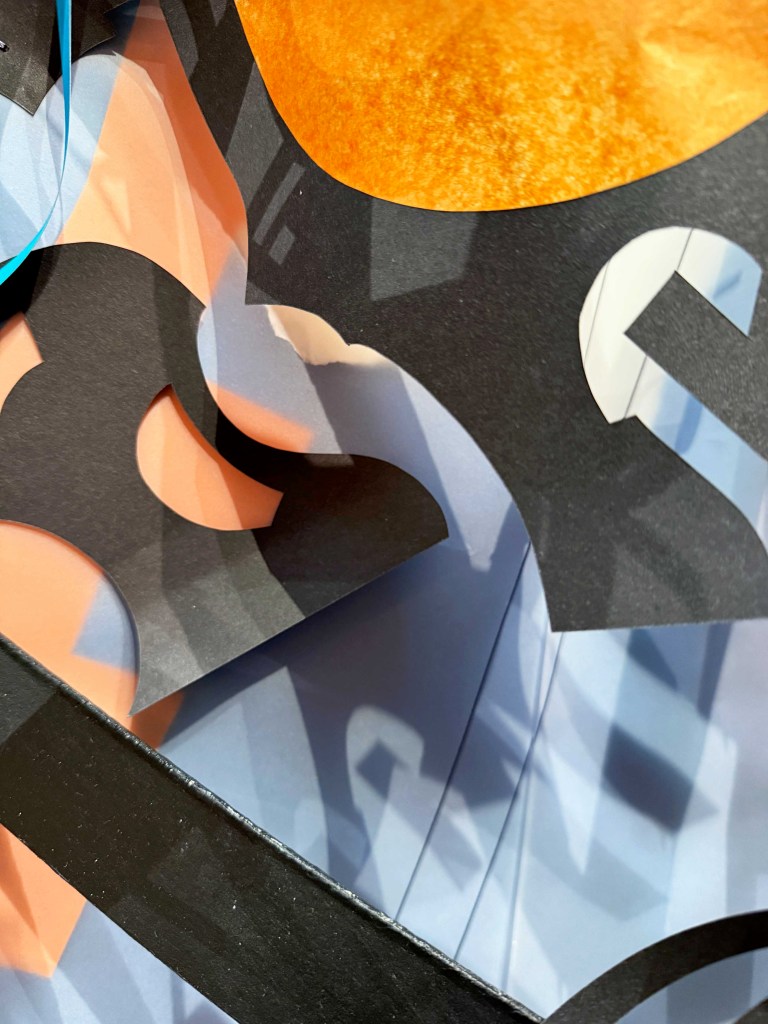
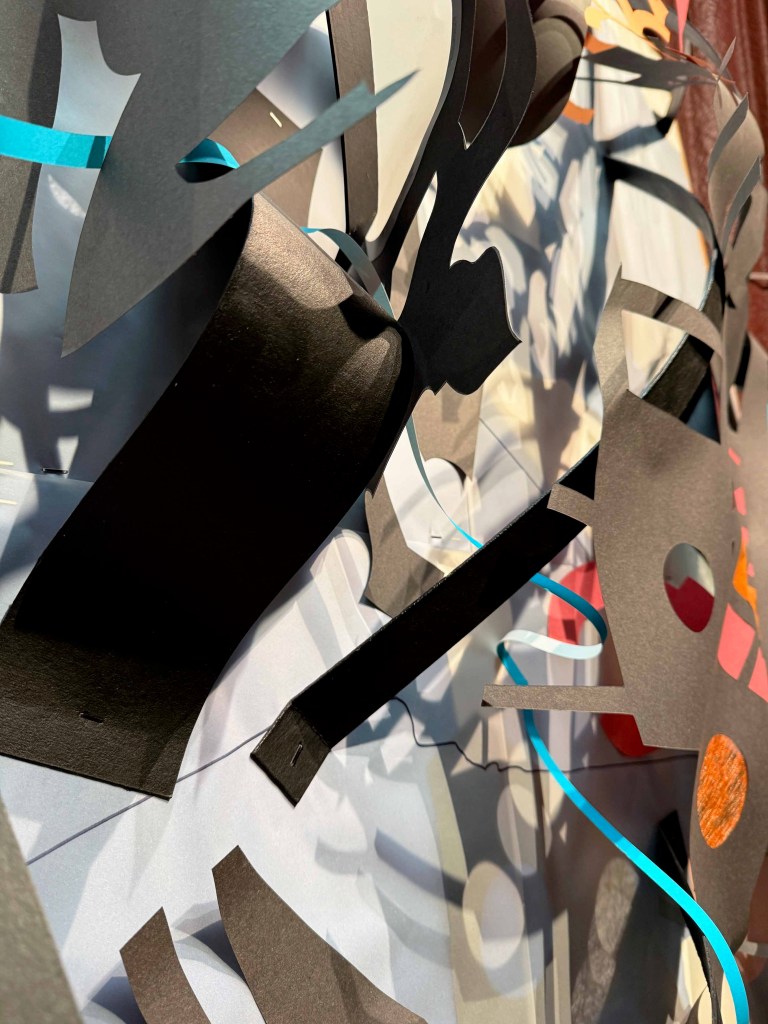
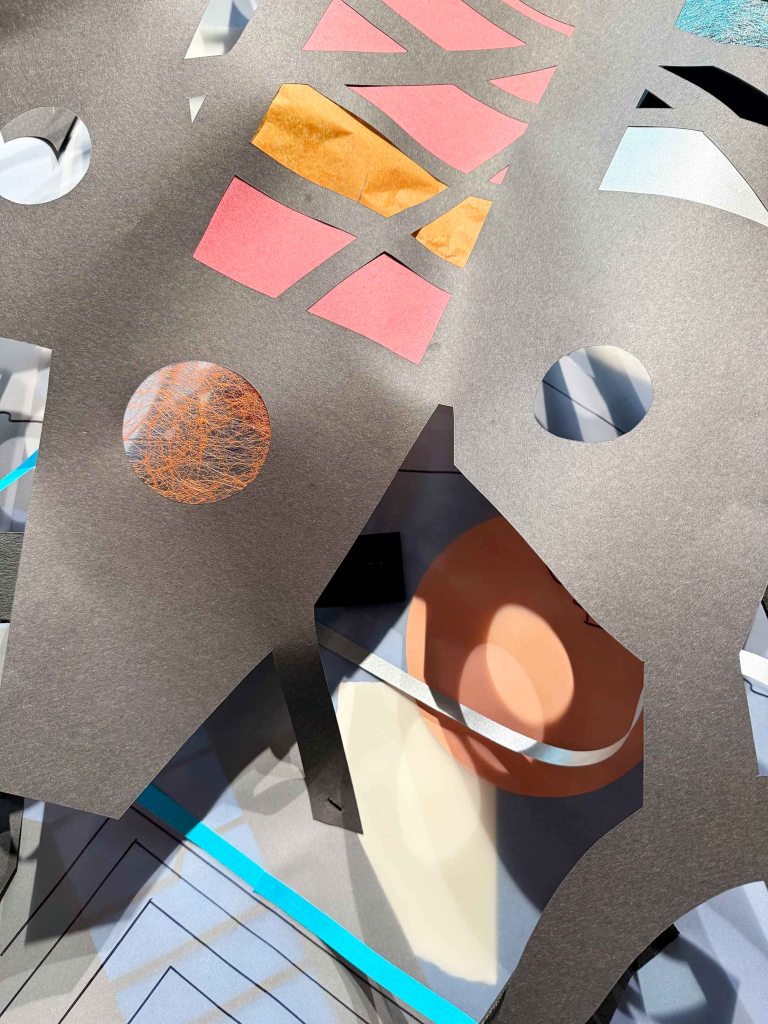
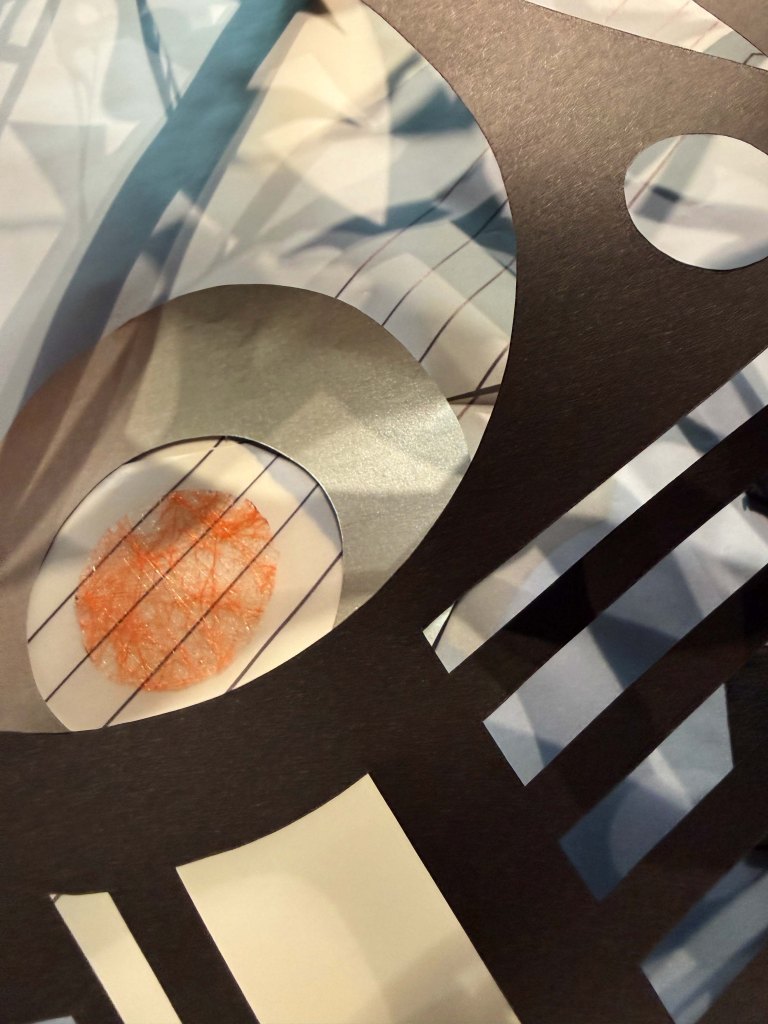
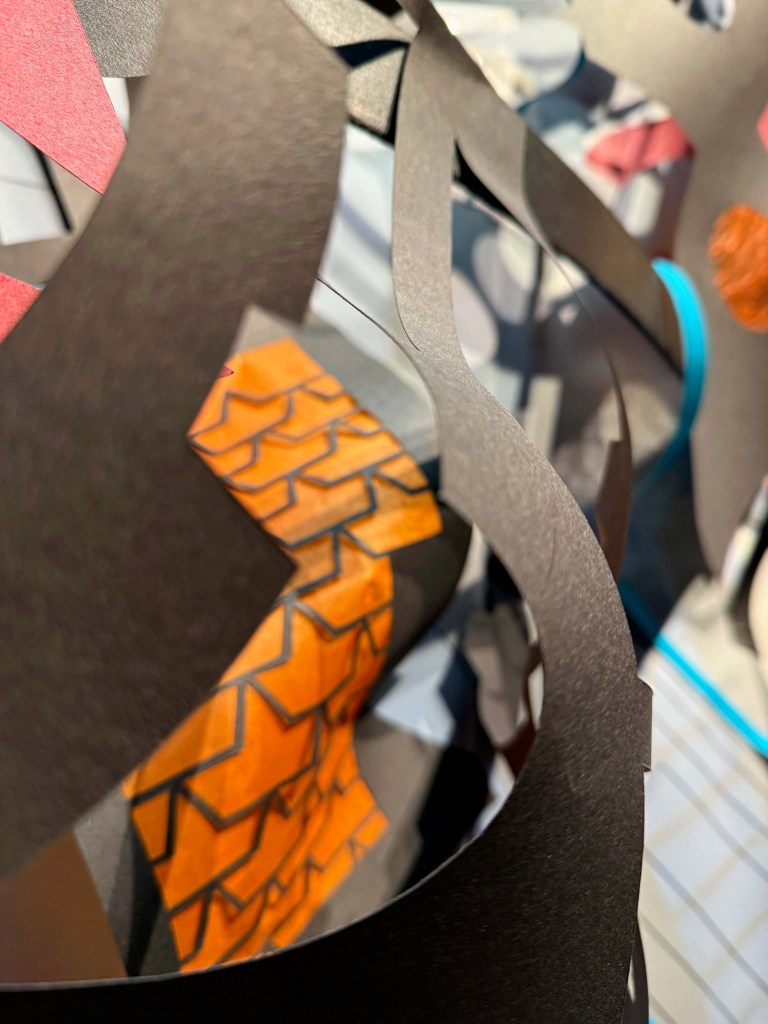
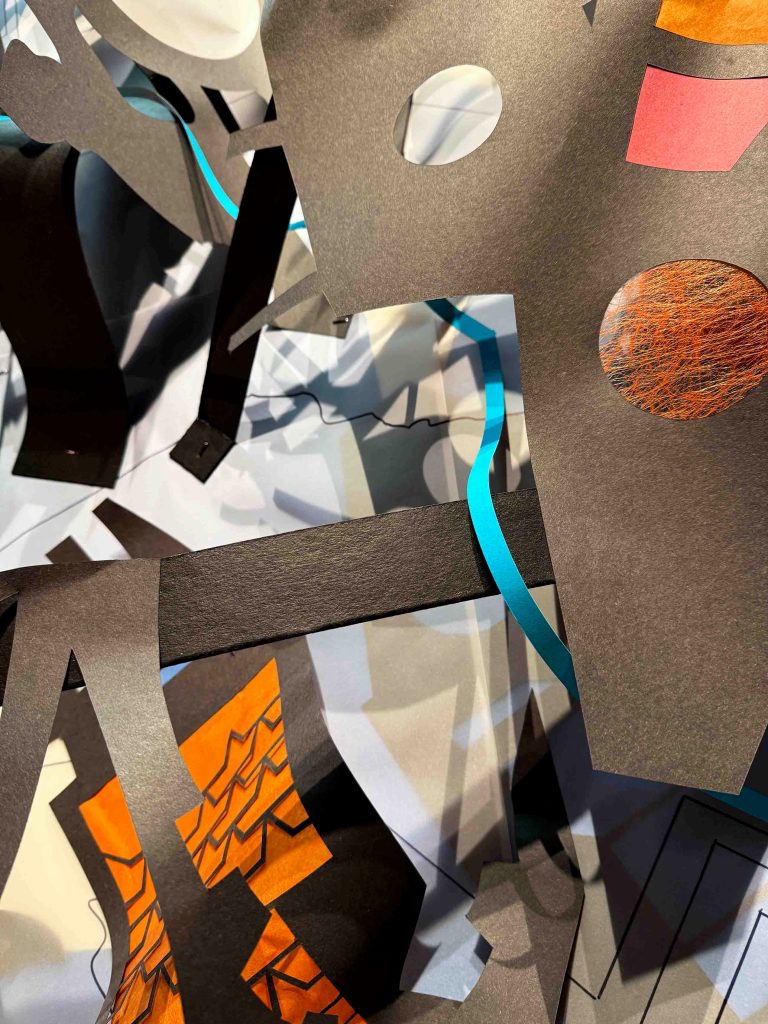
The finished piece generated a great deal of material that can be carried forward into the next stages of the project (see the photos below).
The technological infrastructure was not especially legible in the finished work. When I asked people what they thought might be going on, I got answers such as maps and music. I need to think about how much this matters. My suspicion is that context would make a difference, and that the piece might be read differently if seen alongside the paintings I showed in Leith.
It would also be interesting to see what happens if I introduce more permanent materials, such as wood, acetate, or perspex.
It might be worth trying to replicate this process in the studio as a kind of test bed. I could easily buy some baton from B&Q and build a simple framework to work onto.
 Ben Lingard
Leave a comment